Exercises for the running season
How to get your body in top shape
The running season is just around the corner and many runners want to start clocking up the kilometres again.
However, if you only run and do not do any additional training, you risk overexertion or injury. Targeted strength and stability training helps to better prepare the body for the strain and remain fit in the long term.
With the right exercises, you will not only improve your running technique, but also your stability and efficiency when running. This will enable you to achieve your goals in the coming running season in a healthier and more sustainable way.
To help you perform the exercises correctly, Günther from Injoy Kaprun shows you what is important for each movement. Together, we have put together a selection of effective strength and stability exercises that will prepare you optimally for the coming running season.

Why is supplementary training important for runners?
Even though running seems simple at first glance, it is a complex movement that involves many muscle groups working simultaneously. The legs, hips and torso in particular must work together in a stable manner so that the body can cope well with the strain over a longer period of time.
Without supplementary training, muscular imbalances often occur. These can lead to typical running problems, for example in the knee, Achilles tendon or lower back. Targeted training strengthens the stabilising muscles and improves running posture at the same time.
Above all, a strong core plays an important role in this. It ensures that the upper body remains stable and that energy is transferred efficiently into the running motion. The result is a more economical running style and a lower susceptibility to injury.
When should I start the exercises and how often should I train?
Ideally, you should start the exercises a few weeks before beginning your more intensive running phase. This gives your body enough time to get used to the additional strain and build up muscle.
For most runners, two short training sessions per week are perfectly sufficient. Even 20 to 30 minutes per session can make a big difference. The exercises can be done either after a light run or on a separate training day.
Regularity is particularly important. Continuous training ensures that stability, strength and flexibility improve in the long term. This makes your body more resistant to the stresses of running training.

Which exercises are particularly useful for runners?
For good running performance, you need stable legs, strong hips and a powerful core. The following exercises, compiled by Günther from Injoy Kaprun, are ideal for training precisely these areas.
1. Thruster
Thrusters combine a squat with a subsequent overhead press of the weight.
Benefits of the exercise:
-
strengthens legs and core
-
improves upper body stability
-
supports a powerful running motion
Tip: Ensure that your movements are fluid and keep your upper body stable during the exercise.

2. Lunge with squat
In this exercise, a lunge forward is followed immediately by a squat.
Benefits of the exercise:
-
strengthens legs and buttocks
-
improves balance and stability
-
supports efficient running movement
Tip: Ensure that your front knee remains stable above your foot.
3. Bent over row
When rowing, the upper body is tilted slightly forward and the weights are pulled towards the body in a controlled manner.
Benefits of the exercise:
-
strengthens the upper back
-
improves posture when walking
-
stabilises the torso
Tip: Keep your back straight and pull your elbows back close to your body.
4. Single-leg deadlift
The upper body is tilted forward while one leg is stretched out behind.
Benefits of the exercise:
-
improves balance and coordination
-
strengthens the rear leg muscles
-
stabilises the hips and torso
Tip: Ensure that your hips and upper body remain in line.
5. Weighted Sit-up
From a supine position, the upper body is raised in a controlled manner while holding a weight upwards.
Benefits of the exercise:
-
strengthens the abdominal muscles
-
improves trunk stability
-
supports stable running posture
Tip: Perform the movement slowly and in a controlled manner.
6. Russian Twist
The upper body is leaned back slightly and the weight is shifted alternately to the left and right sides.
Benefits of the exercise:
-
strengthens the lateral abdominal muscles
-
improves rotational stability
-
supports stable walking movement
Tip: Keep your back straight and perform the turn in a controlled manner.
7. Dead bug with weights
Lying on your back, stretch your arms and legs diagonally and then bring them back together again.
Benefits of the exercise:
-
improves torso stability
-
promotes coordination
-
supports stable running posture
Tip: Keep your lower back on the floor during the movement.
8. Plank with rotation
From the forearm support position, open your upper body to the side and stretch one arm upwards.
Benefits of the exercise:
-
strengthens the lateral trunk muscles
-
improves stability and control
-
supports stable walking movement
Tip: Ensure that your hips and body line remain stable.
9. Side plank
The body is stabilised sideways on the forearm and kept in a straight line.
Benefits of the exercise:
-
strengthens the lateral abdominal muscles
-
stabilises the hips
-
improves running stability
Tip: Keep your body in a straight line from head to toe.
10. Lunge with rotation
In the lunge position, the weight is held in front of the body and the upper body is turned to the side.
Benefits of the exercise:
-
strengthens legs and core
-
improves balance and stability
-
promotes controlled running movement
Tip: Perform the rotation slowly and in a controlled manner.
11. Reverse lunge with knee lift
From the backward lunge, bring your back leg forward to lift your knee.
Benefits of the exercise:
-
strengthens legs and buttocks
-
improves balance and coordination
-
supports stable walking movement
Tip: Keep your upper body upright and perform the movement in a controlled manner.
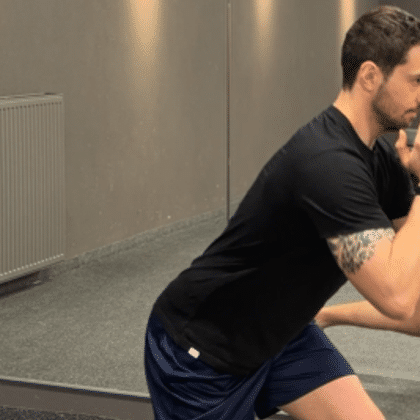
Warm up & Cool Down

Conclusion: Supplementary training makes you a better runner
If you want to prepare yourself optimally for the running season, you should integrate specific exercises into your training plan in addition to running training. Just a few sessions per week can help improve stability and reduce the risk of injury.
A stronger body also means better running technique and greater efficiency on the track. This will help you achieve your running goals while staying healthy and injury-free in the long term.