Safety on the slopes: ski helmet, back protector and rules on the slopes
Which ski helmet is right for you, when is a back protector a good idea, and what are the FIS rules on the slopes? Your guide to staying safer on the mountain.
A perfect day’s skiing doesn’t just begin with the first run. Safety on the slopes starts with choosing the right equipment. A well-fitting ski helmet, a suitable back protector and well-maintained equipment can all help to reduce the risk of injury. Equally important are a realistic assessment of your own ability and showing consideration towards other winter sports enthusiasts.
If you want to stay safe on the slopes, you should therefore not only rely on high-quality equipment, but also be familiar with the key rules on the slopes. We’ll show you what to look out for when choosing a ski helmet and back protector, and how to behave correctly on the slopes.
What should you look out for when choosing a ski helmet?
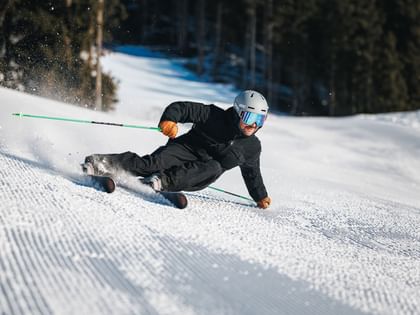
Nowadays, a ski helmet is an essential piece of kit for skiing and snowboarding. It’s not just a question of wearing a helmet; it must also fit the shape of your head, be adjusted correctly and stay securely in place whilst you’re on the slopes.
When buying a helmet, make sure it has the appropriate certification. The EN 1077 standard is particularly relevant for ski helmets. It distinguishes between Class A and Class B helmets. Class A helmets cover a larger area of the head and ears. Class B helmets usually offer a wider field of vision and better ventilation.
Modern helmets often feature additional technologies designed to reduce rotational forces caused by an oblique impact or to distribute the impact energy more effectively. These include, for example, MIPS and manufacturer-specific protection systems such as AMID.
Ventilation also plays an important role. It helps to regulate the temperature under the helmet and wick away moisture. Practical features such as an easy-to-use fastening, removable inner padding or individual size adjustment further enhance comfort.

How do you work out the right size ski helmet?
First, measure the circumference of your head. To do this, place a tape measure horizontally around your head, about one centimetre above your eyebrows. The measurement, in centimetres, will help you choose the right size. When trying on the helmet, it should fit snugly and evenly without causing any uncomfortable pressure points. With the chin strap undone, gently move your head from side to side.
The helmet should follow this movement and not slip. There should be enough space for about one to two fingers between your chin and the fastened strap. It’s best to try on the helmet and ski goggles together. That way, you can tell straight away whether they work well together and whether there’s an annoying gap between the helmet and the goggles. With a helmet that has a visor, the helmet and the visor are already designed to fit together.
When should a ski helmet be replaced?
After a serious fall, the helmet should be checked thoroughly. Damage to the interior is not always visible from the outside. If in doubt, replacing the helmet is the safer option. Even without a fall, the material deteriorates due to UV radiation, temperature fluctuations, moisture and frequent use.
Visible cracks, deformities, damaged fastenings or heavily worn padding are clear indications that the helmet should no longer be used. You should also follow the manufacturer’s recommendations regarding the helmet’s service life.
Tipp: Atomic Revent GT AMID Visor HD Photo
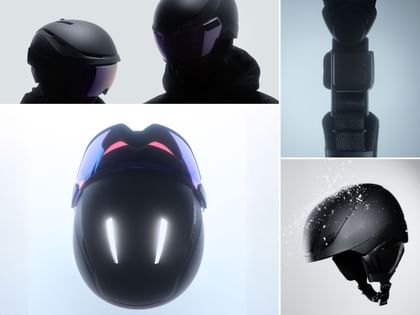
The Atomic Revent GT AMID Visor HD Photo combines a ski helmet with a fully integrated visor. The visor can be raised and lowered and fits snugly against the face. The HD lens technology is designed to enhance colours, clarity and contrast. This can help you to perceive contours in the snow more clearly, particularly in changing visibility conditions.
The helmet utilises AMID 360° technology to provide impact protection. The hybrid construction combines protection with a comparatively lightweight design. Live Fit and the 360° Fit System allow for a personalised fit to the shape of the head. The Active Aircon ventilation system promotes air circulation whilst riding.
Other features include a removable and washable inner lining, Merino 3M X-Static fabric, a magnetic Fidlock fastening and audio-compatible ear pads. The helmet is certified to, amongst other standards, CE EN 1077:2007 Class B.
Who needs a back protector when skiing?
A back protector is no longer confined to racing, snowparks or freeriding. It can also be a useful addition to your protective kit for everyday skiing. This is particularly true when skiing aggressively, at higher speeds or on busy slopes. Protectors can provide additional protection for the back in the event of an impact and distribute the forces involved over a larger area. However, they do not prevent every injury and
They are no substitute for careful skiing or consideration for others. Generally speaking, there are hard-shell protectors and softer vest-style options. Protective vests usually fit closer to the body, offer plenty of freedom of movement and can be worn comfortably under a ski jacket. It is crucial that the protector fits the length of your back and sits neither too high nor too low.
What do the protection classes for back protectors mean?
Back protectors are tested in accordance with EN 1621-2. A distinction is made between Level 1 and Level 2. Level 1 protectors offer basic protection and are often particularly light and flexible. Level 2 models must achieve lower residual forces during testing, but may be slightly heavier or bulkier as a result. Which protection class is suitable for you depends on the intended use,
depends on your riding style and your personal requirements. It’s always important that you actually enjoy wearing the protector. A model with a higher protection rating is of little use if it doesn’t fit properly, restricts your freedom of movement or ends up staying in the wardrobe as a result.
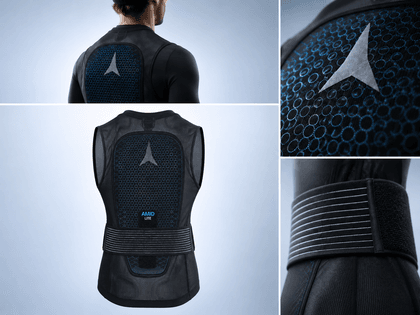
Tipp: Atomic Live Shield AMID Lite Vest
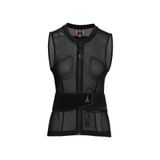
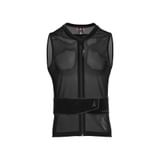
The Atomic Live Shield AMID Lite Vest is a lightweight and flexible back protector for men and women. The AMID Lite Body technology absorbs energy on impact and distributes it over a larger area. At the same time, the vest offers certified Level 1 protection in accordance with EN 1621-2:2014.
Thanks to its slim fit, the protector is barely noticeable under a ski jacket and moves effortlessly with you whilst skiing. The stretchy Air Mesh also ensures breathability and a comfortable fit. A height-adjustable waist strap keeps the vest securely in place and can be removed if required.
Weighing 380 grams for the women’s model and 400 grams for the men’s model, the protective vest remains pleasantly light. This makes it particularly suitable for skiers who want to protect their backs without compromising on freedom of movement or comfort.
What are the ten FIS rules that apply on the slopes?
Good protective equipment is important, but your own behaviour remains the key factor in safety. The ten FIS rules of conduct form the basis for considerate behaviour towards others whilst skiing and snowboarding:
- Be considerate: Behave in such a way that you do not endanger or harm others.
- Control your speed: Ride within your sight and adjust your speed and riding style to suit your ability, the terrain, the snow, the weather and the volume of traffic.
- Choosing the correct lane: Drivers approaching from behind must choose a lane that does not endanger those ahead of them.
- Overtaking at a safe distance: Overtaking is permitted from all sides, provided there is sufficient space.
- Pull in and set off safely: When pulling in, setting off and driving uphill, make sure you are not putting anyone at risk.
- Do not stop in areas with poor visibility: Do not stop in narrow sections or behind crests unless absolutely necessary. Clear such areas as quickly as possible after a fall.
- Staying at the edge of the slope: Anyone walking up or down the slope should stay at the edge of the run.
- Pay attention to road markings: Follow all road signs, markings and traffic signals.
- Providing assistance in the event of an accident: Everyone is obliged to provide assistance in the event of an accident.
- Provide personal details: Those involved and any witnesses must provide their personal details in the event of an accident.
The FIS rules apply equally to skiers and snowboarders. They serve as a benchmark for responsible behaviour in organised ski areas.
Wie trägt gut gewartetes Material zur Sicherheit bei?
Nicht nur Helm und Protektor müssen passen. Auch Ski, Skischuhe und Bindung sollten regelmäßig überprüft werden. Die Bindung muss auf die fahrende Person abgestimmt und fachgerecht eingestellt sein. Körpergewicht, Größe, Alter, Sohlenlänge des Skischuhs und Fahrkönnen spielen dabei eine wichtige Rolle.
Kontrolliere außerdem regelmäßig die Kanten und Beläge deiner Ski oder deines Snowboards. Griffige Kanten unterstützen die Kontrolle auf harten und eisigen Pisten. Beschädigte Skischuhe, stark abgenutzte Sohlen oder lockere Teile sollten vor dem nächsten Skitag überprüft werden.
Eine fachgerechte Bindungseinstellung und ein regelmäßiger Ski- und Boardservice sorgen dafür, dass dein Material zuverlässig funktioniert. Sicherheit beginnt also bereits vor der Auffahrt mit der Gondel.

Conclusion: Stay safe on the road with the right advice
Safety on the slopes is made up of several key elements. A suitable ski helmet protects the head, a back protector complements your personal protective equipment, and the FIS rules ensure that everyone shows consideration for one another on the slopes.
It is essential that your kit fits properly and is suitable for your activity. You should therefore seek advice when choosing a ski helmet and back protector, and try the products on with your ski clothing.