How do I find the right ski boot?
How to find the perfect fit
A day’s skiing starts with the right feel in your feet. But tight spots, numb toes or sore shins can quickly spoil the fun on the slopes. It doesn’t have to be that way. After all, the right ski boot not only ensures comfort, but also optimal power transfer, greater control and, as a result, a better skiing experience. We’ll show you what to look out for when choosing your ski boots and why the perfect fit goes far beyond just the right shoe size.
Why Is the Right Ski Boot Fit So Important?
No two feet are alike. While some people have narrow feet and a low instep, others need more room around the forefoot or calf. That's exactly why ski boots come in different shapes, last widths and flex ratings.
A well-fitting ski boot wraps evenly around your foot, keeps your heel securely in place and allows direct power transfer to your skis.
If the boot is too large, your foot loses stability. If it's too tight, uncomfortable pressure points can develop.
Our expert tip: A ski boot should fit snugly and precisely without causing uncomfortable pressure. What matters isn't how comfortable it feels when you first put it on, but how well it supports your foot while skiing.
What Is the Right Ski Boot Size?
Unlike everyday footwear, ski boot sizes are usually given in Mondopoint, which is based on your foot length in centimetres. For example, a foot measuring 27 centimetres corresponds to a Mondopoint size of 27.0.
To measure your foot length yourself, stand on a sheet of paper with your heel against a wall, ideally in the late afternoon. Mark the position of your longest toe and measure the distance to the wall. Repeat with your other foot, as slight differences in size are perfectly normal.
Important: Your usual shoe size isn't a reliable guide. Ski boots need to fit much more precisely than everyday shoes. The fit also varies depending on the model.
Narrow or Wide Feet: Which Ski Boot Last Width Is Right for You?
In addition to length, the width of your foot plays a crucial role. The so-called last width describes how much room a ski boot provides around the forefoot. It is usually measured in millimetres and often refers to a reference size of Mondopoint 26/26.5.
The following ranges provide a general guide:
-
Approx. 96 to 98 mm: Narrow feet
-
Approx. 99 to 101 mm: Medium-width feet
-
Approx. 102 mm and above: Wider feet
These values are only a guide. Instep height, heel shape and overall foot volume also influence which ski boot will actually fit.
Particularly if you have wide feet, it's important not to simply choose a larger boot size. While this may create more room around the forefoot, it can also compromise the essential support around your heel.
What Does Flex Mean in Ski Boots?
Flex describes the resistance a ski boot provides when you lean forwards. As a general rule, the higher the flex rating, the stiffer the boot.
A softer flex makes it easier to move within the boot and can be particularly comfortable for beginners or recreational skiers. More performance-oriented skiers often benefit from a higher flex rating, as it supports more direct power transfer and precise control.
However, the right flex doesn't depend solely on your skiing ability. Your body weight, skiing style and personal preferences also play a role. Flex ratings from different manufacturers are not always directly comparable.
The key is being able to flex the boot forwards in a natural skiing position while maintaining control and support.
Buckles or BOA®: Which Closure System Is Better?
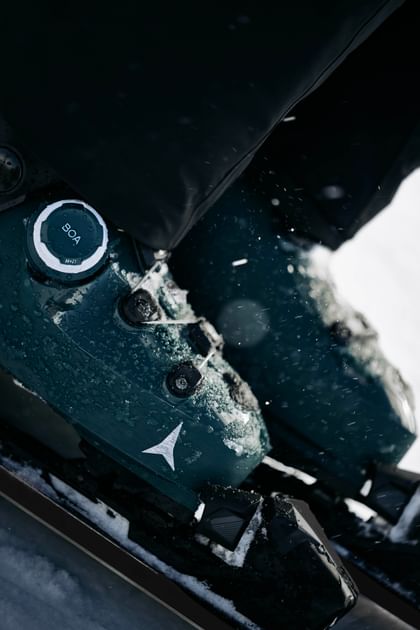
Ski boot closure systems have also evolved significantly in recent years. Alongside traditional buckles, more and more ski boots now feature the BOA® Fit System.
While traditional buckles can be fastened and adjusted at individual points, the BOA® Fit System allows precise, incremental adjustments using a dial-based closure system. This helps the shell wrap more evenly around your foot.
Both systems have their advantages. What matters most is how well the ski boot adapts to the shape of your foot and how securely it holds it in place.
Find out more about the technology and its benefits in our magazine article on BOA® ski boots.
Our Product Recommendation: Atomic NEXUS BOA. Where Comfort Meets Performance
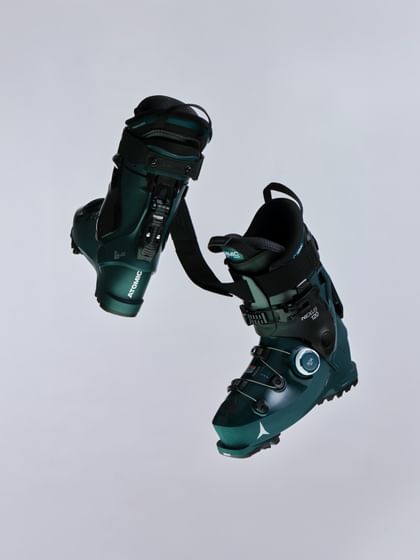
If you don't want to compromise between comfort and performance on the slopes, the new Atomic NEXUS BOA range is well worth a closer look. What makes it special? These ski boots combine exceptionally easy entry and exit with the stability and direct power transfer of a traditional alpine ski boot.
Easy Entry Thanks to NexStep Construction
At the heart of the range is the innovative NexStep construction. The QuickFlip lever at the back allows the cuff to open wide, making it significantly easier to put the boots on and take them off, without sacrificing the stability of an overlap construction for skiing downhill.
A Personalised Fit with BOA® and Set-and-Forget
The bidirectionally adjustable BOA® Fit System enables precise adjustment around the foot. It is complemented by the Set-and-Forget buckle, which allows you to customise the fit around your calf once and retain that setting even when putting the boots on or taking them off.
More Room for Higher-Volume Feet
With a generous 101 mm last and a fit designed for higher-volume feet, the NEXUS range provides extra room, particularly for medium to wider feet. The removable spoiler also allows the fit to be adjusted to different calf shapes.
The heat-mouldable Mimic liner and Memory Fit technology offer further customisation, allowing the shell and cuff to be adjusted in-store.
Our Recommended Models:
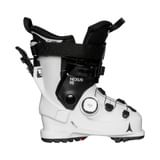
The Atomic NEXUS 110 BOA, with its 110 flex rating, offers a balanced combination of stability, control and comfort for performance-oriented skiers. The Atomic NEXUS 95 BOA W, with its 95 flex rating, is specifically designed for female skiers who value responsive performance and easy entry.
How Do I Try On Ski Boots Properly?
Trying on the boots is one of the most important steps in finding the right pair of ski boots. Make sure you allow plenty of time for this and wear thin, functional ski socks. Thick socks can affect the fit and cause additional pressure points.
When standing upright, your toes should just touch the front of your shoes. As soon as you bend your knees and assume a natural skiing position, the pressure at the front should ease off. At the same time, your heel must remain stable in the boot and must not slide up noticeably when you lean forwards.
When trying on the ski boot, wear it for at least 15 minutes and move into the typical skiing position several times. This will help you spot any potential pressure points more easily than if you just slip it on briefly.
It is also important to note that you do not need to tighten the buckles or the BOA® system excessively to achieve a secure fit. A well-fitting ski boot already sits securely on the foot thanks to its shape.
3D Foot Scanning at Bründl Sports: Because Every Foot Is Unique
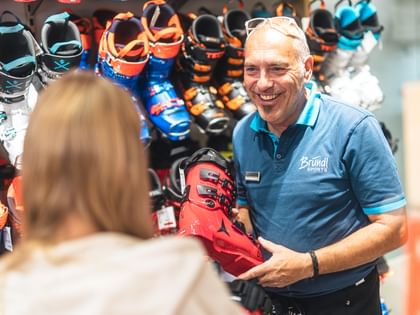
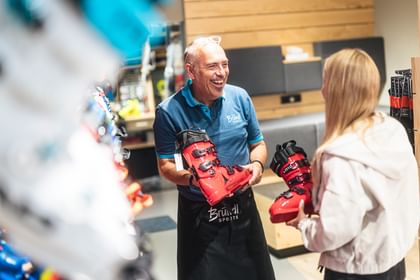
Finding the perfect fit starts with truly understanding your feet. That's where professional ski boot fitting advice at Bründl Sports comes in.
Using our 3D foot scanner, our experts capture the individual characteristics of your feet. This includes analysing foot length, width and volume, providing a precise foundation for selecting a ski boot that suits your anatomy.
Even two feet of exactly the same length can have completely different requirements when it comes to ski boots. A high instep, narrow heel or wide forefoot can make a crucial difference when choosing the right model.
Our experts combine the results of your foot analysis with your skiing ability, personal needs and preferred skiing style. That way, you won't just find any ski boot, but the one that's truly right for you.

Bootfitting: Turning a Good Ski Boot into Your Perfect Ski Boot
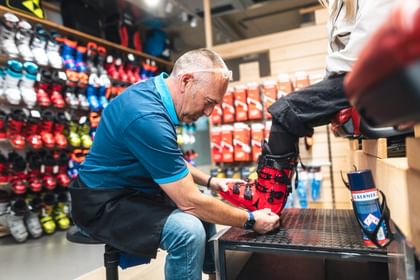
Even a carefully chosen ski boot may still have room for improvement in certain areas. That’s exactly what the professional boot fitting service at Bründl Sports is for.
During a boot fitting, your ski boot is customised to the shape of your foot. Depending on the model and your needs, the outer shell and liner can, for example, be adjusted using targeted heat treatment. This helps to reduce pressure points and further optimise the fit.
Boot fitting is particularly useful for those with specific anatomical features, such as a high instep, sensitive ankles or feet of different shapes. However, ambitious skiers also benefit from a precise fit when it comes to secure support and optimum power transfer.

Your Bootfitting Appointment: Book Online Now
Professional ski and racing boot fitting is only available by appointment. Therefore, we kindly request that you schedule a suitable appointment for this service.
This saves you waiting time and ensures you receive advice that is tailored precisely to your needs.